
How Shouting Affects a Child’s Brain: The Science-Backed Truth Every Parent Should Know
Introduction: The Moment Before the Yell
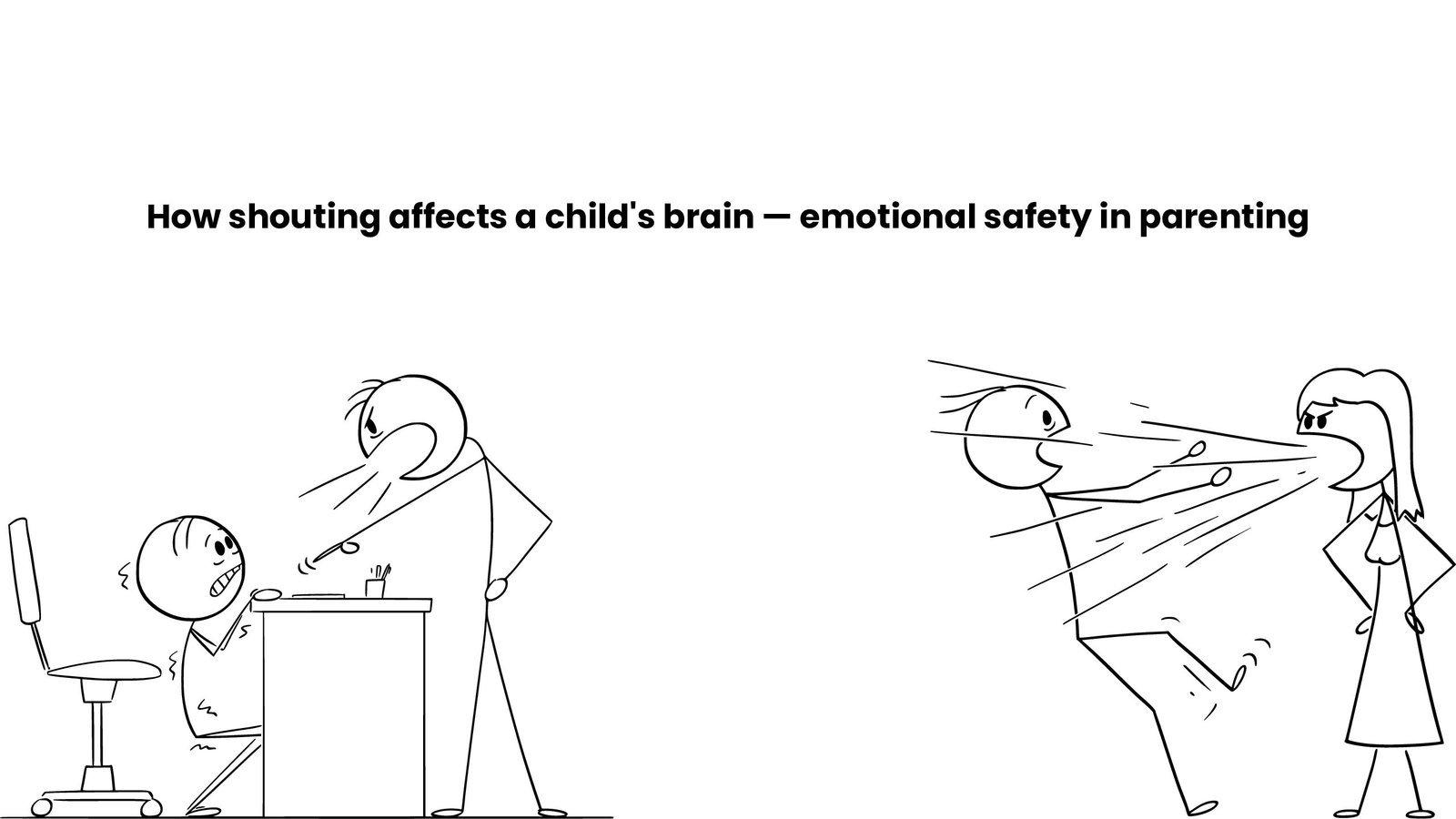
Imagine you’re four years old. You accidentally spill your juice. Before you even have a chance to react, a loud voice yells. In that single moment, something quietly profound happens inside a developing brain — and it isn’t learning.
It’s fear.
Every parent has raised their voice at some point. It’s human. But understanding how shouting affects a child’s brain can completely change the way we respond to everyday parenting moments — from spilled juice to bedtime battles. This article breaks down the neuroscience behind yelling, why it backfires, and what truly helps children learn, grow, and feel safe.
What Happens in a Child’s Brain When You Shout
When a child is shouted at, their brain doesn’t process the lesson you’re trying to teach. Instead, it processes danger.
Here’s what’s happening neurologically:
- The amygdala activates — this is the brain’s alarm system, responsible for detecting threats and triggering fear responses.
- The body freezes — a survival instinct kicks in, making the child feel physically unsafe.
- The prefrontal cortex goes offline — this is the part of the brain responsible for reasoning, impulse control, and learning from mistakes.
In short, shouting shifts a child’s brain from learning mode into survival mode. And a brain in survival mode cannot absorb a lesson — it can only react to a threat.
This is why a simple spilled glass of juice can suddenly feel, to a small child, like the biggest mistake in the world.
The Long-Term Effects of Yelling on Children
A single shouting episode won’t define a child’s future. But repeated exposure to yelling can leave a lasting imprint on how their brain and emotional patterns develop.
Research and child psychology consistently point to several long-term effects:
- Difficulty regulating emotions as they grow older
- Lower self-esteem and increased self-doubt
- Heightened stress responses, even in low-stakes situations
- Reactive behavior patterns that mirror what they experienced — fear first, thinking second
Over time, children who are frequently shouted at may carry these patterns into adolescence and adulthood, affecting how they handle conflict, criticism, and stress in their own relationships.
Why Children Don’t Need Perfect Parents — They Need Emotional Safety
Here’s the reassuring truth: children aren’t expecting perfection from their parents. No parent gets it right every time, and that’s not the goal.
What children actually need is to feel emotionally safe with the adults raising them.
When a child feels safe:
- They are more able to listen without shutting down
- They can understand their mistakes instead of just fearing punishment
- They are better equipped to learn and grow from what happened
But when a child feels overwhelmed by yelling or fear, their brain prioritizes survival over learning — making it nearly impossible to absorb the lesson a parent is trying to teach.
Positive Parenting Isn’t Permissive Parenting
A common misconception is that calm parenting means letting bad behavior slide. It doesn’t.
Positive parenting is not about avoiding discipline — it’s about how that discipline is delivered.
It means:
- Setting clear, consistent limits
- Responding with patience instead of volume
- Addressing the behavior without attacking the child’s sense of safety
- Supporting healthy emotional and brain development while still holding boundaries
Children can absolutely learn right from wrong without being yelled at. In fact, they learn it more effectively when their thinking brain — not their fear response — is in charge.
The Real Impact of Choosing Patience Over Volume
Every time a parent chooses patience instead of yelling, they’re doing more than managing a single moment of misbehavior. They’re shaping something much bigger: the inner voice their child will carry for the rest of their life.
That inner voice will either say:
“I am safe, even when I make mistakes,”
or
“I am only safe when I don’t mess up.”
That distinction shapes confidence, resilience, and emotional health well into adulthood.
Key Takeaways
- Shouting activates a child’s fear response, not their learning response.
- Repeated yelling can affect emotional regulation, self-esteem, and stress responses long-term.
- Children need emotional safety, not perfect parents.
- Positive parenting still includes boundaries and discipline — just delivered without fear.
- Calm, consistent responses build the foundation for lifelong emotional resilience.
Final Thoughts
Understanding how shouting affects a child’s brain isn’t about parental guilt — it’s about awareness. Every parent raises their voice sometimes. What matters most is the pattern over time, and the willingness to choose connection over reaction whenever possible.
The next time the juice spills, the toy breaks, or the tantrum erupts, remember: you’re not just handling a moment. You’re shaping a brain — and the calm, steady version of you is the one your child will carry with them for life.